


Fiber Cement Board Splitter: Separating Cured Sheets without Damaging the Product


A Fiber Cement Board Splitter is useful when cured boards must be separated from the pads or supports used during treatment and prepared for the next stage of production. It is not the machine that forms a wet sheet, and it is not interchangeable with the mould-plate stripping equipment used elsewhere in a board line. Zhonghong lists a Board Splitter for separating cured boards from curing pads and stacking sheets for further processing. A buyer should establish the incoming load arrangement, the condition of the cured boards, where released pads will go and which equipment will receive the sheets afterward. The company’s equipment range also includes an Autoclave Curing System, Roller Conveyors, Sanding Machines and cured-board Cutting Machines; each plays a separate role in moving acceptable product toward final inspection.
A plant owner may see that cured boards meet their process requirements but still suffer edge damage after the load is opened. Another factory may be able to separate boards successfully while its finishing hall repeatedly waits for a completed output stack. These are not the same problem. The supplier should trace material from autoclave discharge through separation to the next station before proposing a machine with an impressive but unsupported throughput figure.
Identify the cured-board load the splitter must receive
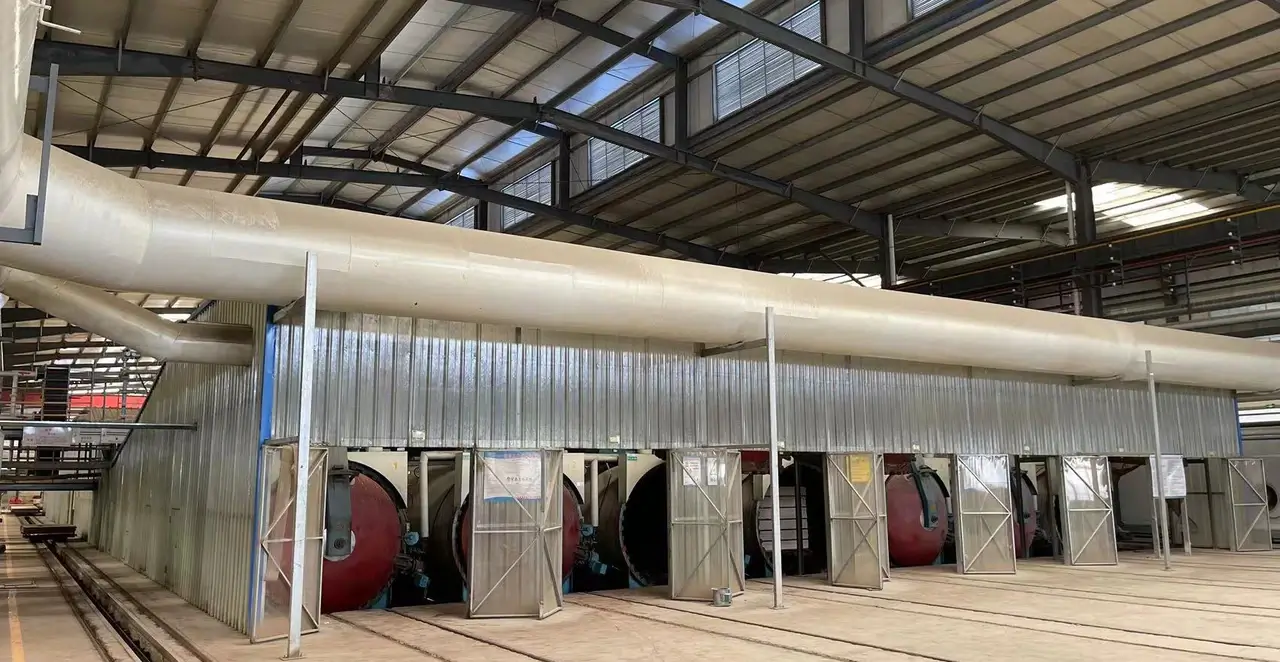
The autoclave treats material in loads arranged around the factory’s chosen product and support system. After curing, individual boards and their supporting pads or interleaving materials must be moved into the next workflow. Zhonghong’s Board Splitter is documented for automatic separation and stacking of cured sheets. The equipment purchase should begin with a drawing of the actual incoming load, not with a generic assumption about the size or number of boards per stack.
Pad arrangement is a design input, not an invisible accessory
A curing pad or support serves a function before separation, but the splitter must be able to distinguish and handle it when the load arrives. The buyer needs to specify what that support looks like, how it is positioned and where it goes after a board has been released. If pads are reused, the proposed plant should also describe their return path and any preparation tasks for which the owner or another machine is responsible.
Imagine a factory changing the thickness of its main board product. Even if overall board dimensions remain constant, its curing-load arrangement may be affected. A supplier should review whether the separation and output handling still suit the planned range. A catalogue photograph does not establish universal compatibility with every pad geometry or stack configuration, and the current Zhonghong site does not publish one fixed pad specification for all installations.
Cured-board integrity should be checked before the first pickup
Boards coming from an autoclave have undergone the selected treatment, yet they can still be damaged by inappropriate handling or misaligned support. A supplier should identify the surface and edge conditions expected at the splitter inlet and what the machine is supposed to preserve. A test that proves mechanical movement without a real board cannot establish every aspect of product-handling quality.
For a factory shipping architectural-facing panels, surface damage may be commercially important. A plant producing less decorative substrate boards may prioritize dimensions or the absence of handling cracks. The buyer should therefore provide representative cured material and an acceptance description rather than rely on a general promise of gentle separation. Good equipment inspection follows the actual board specification.
Board splitting and mould-plate stripping belong to different stages
Both tasks involve separating materials, but their place in the line matters. Zhonghong’s Stripping Machine separates boards from mould plates using suction lifting and servo-controlled travel. The Board Splitter separates cured sheets from curing pads. They have different incoming material conditions, output routes and responsibilities. Buyers should use the precise station name in the equipment schedule and verify that the supplied machine addresses the observed production constraint.
The stripping machine may release plates before the curing stage
Where the selected production route uses mould plates, stripping may be needed to remove a board from its plate. The supplier should describe how the released board continues toward subsequent processing and how the plate returns to its appropriate path. This operation should not be confused with separating curing pads from finished sheets after steam treatment. The mould-plate stripping article examines the two outgoing streams at that earlier station.
A factory buying a replacement separator should identify exactly where damage or waiting occurs. If the failure begins at mould-plate stripping, installing a new Board Splitter later in the process will not correct it. Conversely, if material leaves curing intact and damage begins during pad removal, changing the earlier stripper may add expense without addressing the real problem.
Splitter output must match the following finishing or transport machine
Zhonghong’s equipment catalog includes Roller Conveyors for transferring boards, a Sanding Machine for cured-board surface and thickness work, and a Cutting Machine for finished dimensions. The splitter can prepare sheets for those operations only if the receiving layout is compatible with its output. An equipment drawing should identify the direction of travel, board support, stack location and station readiness signals.
Suppose cured boards are separated successfully but a downstream sanding machine is occupied. The line needs an appropriate response so the splitter does not send material into an unavailable receiving area. The supplier should document whether the proposed machine includes the needed coordination and whether existing conveyors or controls must be modified. A machine-only price without that interface definition is difficult to evaluate.
Separate the pad-return route from the finished-board route
One reason to examine the complete operation is that the board and pad do not necessarily go to the same destination. A splitter that removes boards successfully can still leave the factory with inefficient support recovery if that path is undefined. The process design should show where released boards are collected and where pads are moved or prepared for reuse, according to the selected curing system.
Finished boards should move toward a defined inspection point
After separation, a board may require surface finishing, final cutting, edge preparation or direct movement toward an approved packing operation. Not every product needs every finishing machine. Zhonghong’s Sanding Machine, Grinding & Chamfering Machine and cured-board Cutting Machine perform distinct tasks, and their inclusion should be justified by the board’s commercial specification.
An investor launching a visible wall panel might need to inspect both surface appearance and final dimensions after separation. Another board used as a covered substrate could have a different treatment requirement. A supplier should describe what the splitter delivers to finishing, rather than assume that all cured sheets will enter one fixed downstream sequence. This prevents equipment scope from being driven by a generic turnkey drawing instead of product needs.
Support recovery should be part of the same capacity calculation
If pads or carriers are reused, the factory needs a route for their recovery and return. The detailed handling method depends on the actual supports and plant layout and cannot be inferred from the splitter’s product name. The equipment supplier should identify which handling machines are included and which tasks remain with the owner or existing production equipment.
A factory preparing to expand its curing capacity may need to review both sides of this flow. A greater number of boards leaving the autoclave can increase demand on separation and pad recovery. Purchasing a larger curing vessel without checking downstream transfer may simply move the bottleneck. This is why an accurate plant output estimate follows accepted finished boards rather than only the rated speed of the treatment equipment.
Factory trials should reflect damage risks during separation
A useful inspection of a Board Splitter has two phases. Before shipment, the buyer can verify which mechanical assemblies and control functions are supplied. After installation, the supplier and plant team can use representative cured boards and supports to demonstrate the intended material separation. The machine’s success should be evaluated through the actual production route, not a demonstration that ends after an empty mechanism moves correctly.
Observe material contact and board release under the planned load
For a site trial, the supplier should identify the approved board and support type, the intended sequence of separation and the point at which each output is inspected. If the product leaves with avoidable chips or scratches, the team can then determine whether the problem lies in the incoming load, machine adjustment, transfer support or another operation. A vague acceptance statement such as “machine works automatically” does not answer that question.
The reviewed Zhonghong website describes automated separation and stacking but does not publish a universal throughput, support load, suction arrangement or guarantee for every Board Splitter. Those values belong to a model-specific quotation and process test. Borrowing another manufacturer’s figures would make comparison less accurate, particularly when the intended board and pad arrangement differ from its demonstration.
Test a paused receiving station as well as a normal cycle
Imagine the next conveyor cannot receive a separated board. Operators should know whether the splitter pauses, where the board remains supported and when the station can restart safely. The same applies when a released pad cannot continue on its intended return route. These operating sequences should be part of the supplied control narrative and the site’s commissioning plan.
Zhonghong offers Intelligent Line Control Systems and Electrical Control Cabinets for PLC coordination and production monitoring. A buyer should confirm which signals the offered splitter includes and how it exchanges information with neighbouring machinery. For an upgrade to an older factory, the integration may require changes to existing electrical connections or operating procedures, which must be included in the project scope.

When should an operating factory replace its Board Splitter?
The replacement decision should begin with a documented failure or production limitation. Is the old machine unable to handle the approved board range? Are damaged edges associated with separation? Does the station repeatedly wait because its outgoing routes are occupied? These situations may call for different engineering actions. A new machine should solve a specific problem instead of being bought simply because it has a newer controller.
A retrofit must use the existing curing-load and conveyor drawings
A plant keeping its autoclave and curing supports should provide those details to the new supplier. The replacement splitter must receive material as the existing plant actually delivers it, and its outlet must match the retained handling equipment. Site space and maintenance access may also constrain the proposed assembly. A workshop photograph or headline capacity number cannot demonstrate this compatibility.
Where a project adds only the splitter, the contract should state who modifies foundations, control signals and conveyors. Zhonghong’s broader engineering and installation services may be relevant, but the exact work needs to be named. This is especially important if several contractors supply different parts of the final curing and finishing area.
Product inspection is the final test of the separation route
An operator should be able to follow one approved cured board from the load, through pad separation, to the next machine without an unexplained change in condition. The autoclave selection article addresses the curing-load basis, while the sanding equipment guide explains later surface and thickness treatment. Both influence what the splitter is expected to receive and deliver.
The practical supplier decision is to specify the actual cured board and supports, verify that the separator protects the product, and establish workable destinations for both separated materials. When those are clear, the equipment can be assessed by its effect on accepted output, not by an isolated mechanical movement figure.