


Fiber Cement Autoclave Supplier: Vessel Documents, Steam Services and Board Trials


Choosing a Fiber Cement Autoclave Supplier requires a different kind of evaluation from buying a conventional conveyor or finishing machine. An autoclave is pressure equipment, and its manufacturing documentation, applicable safety requirements, installation interfaces and commissioned treatment route must be assessed for the actual project. A buyer should define the fiber-cement or calcium-silicate product, the proposed curing load, the destination and governing requirements, and the responsibilities for steam services and installation before comparing quotations. Zhonghong lists an Autoclave Curing System among its building-board machinery, together with Shuttle Cars, Board Splitters, Electrical Control Cabinets and engineering services for plant design, equipment manufacture, installation and commissioning. These are verified business areas, but the public catalogue does not establish that a particular vessel holds an unnamed certification or meets every country’s pressure-equipment rules.
An investor building a new plant may need a curing hall, treatment equipment and all related site infrastructure. An existing factory may already have a steam source and safe handling route, and only require a replacement or additional vessel. Their equipment questions overlap, but their permitting, installation and interface responsibilities will differ. A credible autoclave supplier recognizes those differences instead of treating the vessel’s nominal dimensions as the entire project.
Ask for the actual pressure-vessel compliance basis before pricing is final
Pressure-equipment obligations depend on the destination, design and intended operation. Engineering codes such as the ASME Boiler and Pressure Vessel Code provide recognized frameworks, while local jurisdictions may impose additional or different obligations. Referring to a code does not prove that the equipment offered has the relevant approval. The buyer needs documentation specific to the vessel proposed, with the applicable requirements agreed by qualified specialists.
A certification claim should identify the vessel and governing standard
A buyer comparing suppliers might receive brochures mentioning inspections, welding quality or pressure equipment compliance. Those statements should lead to an identifiable document for the actual offered unit and its intended destination. A certificate belonging to another plant or model cannot automatically be applied to a new order. Zhonghong’s site lists autoclave machinery but does not publicly show one universal pressure-equipment certificate covering every project configuration.
For a new plant in an export market, ask who will determine the applicable equipment and installation rules and who will produce the necessary documentary evidence. The engineering team should consider this before committing to the vessel design or transport arrangements. Otherwise a mechanically complete piece of equipment may arrive on site while approval or installation work remains unresolved.
Mechanical equipment inspection is not a board-performance certificate
A correctly manufactured pressure vessel can provide the intended treatment environment without guaranteeing the properties of any formulation placed inside it. Fiber-cement and calcium-silicate board properties depend on the actual raw materials, forming process and curing method. A vessel inspection addresses the equipment; a finished-board trial addresses the commercial material produced through the complete process. The supplier agreement should distinguish these milestones.
Suppose an investor intends to use mineral inputs that have not yet passed production trials. It may be possible to specify certain vessel features while the final treatment conditions remain subject to process validation. A responsible supplier should state those assumptions instead of importing a curing time or pressure from another company’s successful board. The buyer needs clarity about what is proven and what remains to be tested.
Define the curing load rather than relying on vessel dimensions alone
A complete curing load includes boards, supports, carriers or trolleys according to the proposed process. The number of saleable sheets that can be treated depends on this arrangement as well as the validated treatment route. Nominal vessel size cannot by itself establish annual plant output. A supplier should provide a load drawing and explain how material moves into and out of the curing area.
Shuttle cars and load carriers must fit the proposed vessel interface
Zhonghong lists a Shuttle Car used to move board or mould-plate trolleys between stations. The autoclave supplier should explain whether such equipment forms part of the proposed project and what the receiving arrangement requires. A trolley transfer must align with the loading route and work with the support system selected for the boards. No universal payload, travel speed or mechanical connection is established by the general product listing.
For an existing factory, retaining its current trolleys may be an important budget condition. The supplier must then confirm whether the proposed vessel and receiving arrangement are compatible with those carriers. A new plant can develop the equipment together, but the engineering decisions should still be documented before construction. An attractive autoclave price that omits necessary loading machinery is not directly comparable with a quotation that includes the complete handling scope.
Unloading and separation influence the next treatment load
After treatment, boards may be separated from curing pads and transferred toward finishing. Zhonghong offers a Board Splitter for this post-curing task. If the splitter or unloading route cannot receive material, an autoclave may remain occupied longer than the treatment operation requires. The supplier should therefore discuss how the complete curing load will leave and which equipment takes responsibility for the boards and supports afterward.
Consider a factory reporting low finished output even though the autoclave reaches its planned treatment milestones. The bottleneck may involve trolley availability, unloading or splitting rather than the vessel itself. A good supplier assessment asks for the whole load movement sequence rather than automatically proposing a larger or additional pressure vessel.
Steam supply and civil work need a signed responsibility boundary
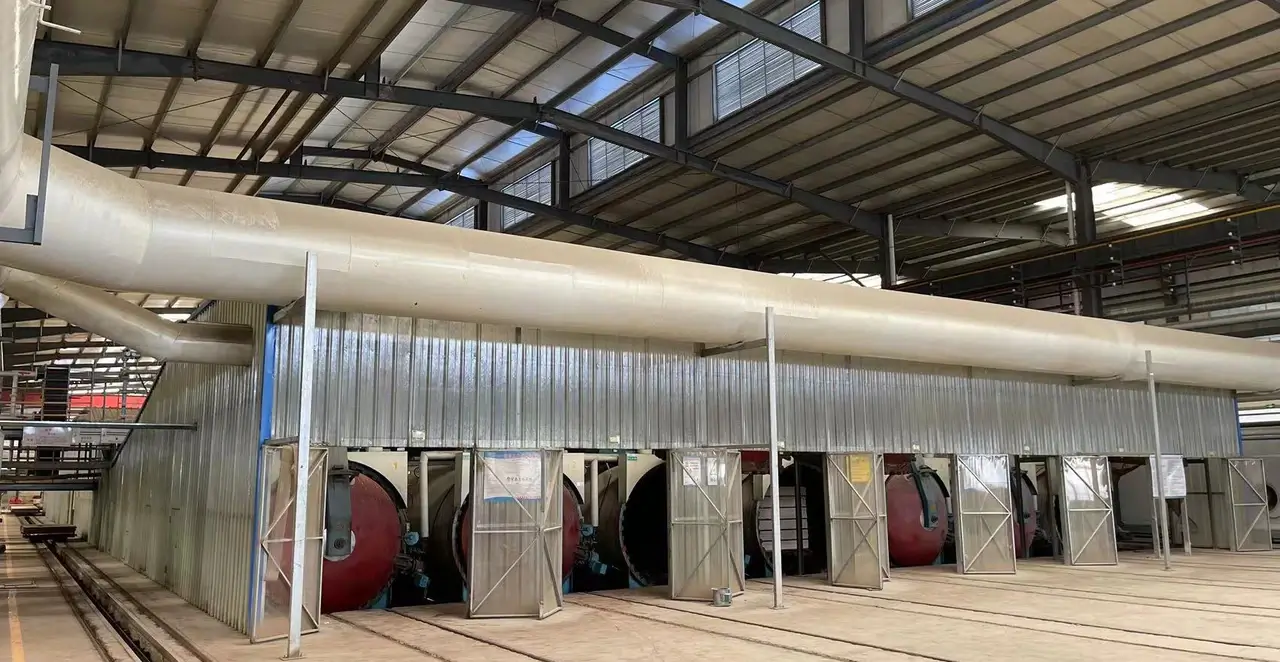
A vessel cannot operate as part of a factory without suitable utilities and installation. Depending on the project, these may involve steam generation or distribution, piping, condensate handling, electrical controls, supports and building work. The buyer and supplier should identify what the equipment order includes and what the owner or local contractors will provide. The exact requirements must be developed by qualified engineers for the actual installation.
Steam services should not be hidden inside the word turnkey
Zhonghong describes process engineering, EPC services, equipment manufacturing and commissioning, but a project-specific contract must identify which parts of the utility system are supplied. One quotation may cover the vessel and certain controls, while another includes additional plant equipment or installation services. Without an agreed responsibility matrix, the buyer may discover later that critical connections were assumed to be someone else’s work.
For a plant owner planning an overseas project, site readiness should be evaluated before the shipment is scheduled. Confirm the design information needed for foundations, safe access and mechanical connections, and identify any local approvals or specialists who must be engaged. A vessel that arrives on time cannot make a factory ready if its steam and installation requirements are unresolved.
Electrical interlocks must be reviewed as a pressure-equipment system
Zhonghong offers Electrical Control Cabinets and Intelligent Line Control Systems for industrial board machinery. A curing installation needs control functions appropriate to the vessel and its operating process, but the site does not publish one universal interlock arrangement or electronic safety certification for every autoclave. The supplier should provide the actual control documentation, and the responsible engineers should determine the applicable machinery and pressure-equipment requirements.
A generic PLC display from another production line does not prove that the proposed curing system includes every necessary function. The buying team should request a functional description and the tests that will be performed during commissioning. Operators must follow the manufacturer’s approved instructions and the safety procedures required for the installation; a marketing article is not a source of operating pressure or temperature settings.
Large pressure-equipment deliveries can also make the factory building itself part of the procurement decision. A buyer should obtain the actual shipping and lifting information and check the access route before the site is enclosed or committed to another construction sequence. These are mechanical-installation planning tasks for the real equipment, not a claim about a particular vessel’s dimensions. An investor who discovers too late that the designed receiving opening cannot accommodate the delivered assembly may face changes that have nothing to do with curing chemistry. The manufacturer’s engineering response should identify what dimensions and handling conditions must be confirmed by the owner and the installation contractor.
Supplier documentation should survive shipment and future maintenance
Autoclave procurement does not end with the equipment leaving the workshop. The owner needs relevant manufacturing and inspection records, assembly instructions and operating information. If the equipment arrives in more than one shipment, each item must be identifiable. Zhonghong offers transport and installation services as business categories, but fixed packing methods, delivery periods and spare-parts terms must be confirmed for the actual order.
Vessel records should match what was manufactured and delivered
A procurement file can connect approved drawings, inspection information, equipment identity and the intended installation. The supplier should say which documents are provided before shipment and which are completed after installation. The buyer should avoid accepting a general workshop photograph or certificate as proof of work on a different pressure vessel.
For a retrofit, the owner may also need to preserve records of the retired installation and identify which site services are reused. Changes to piping, controls or supporting equipment should appear in the final handover documents. Accurate equipment identification is useful not only for immediate acceptance but also for future service, inspection and any regulatory review that applies to the facility.
Spare parts must be named for the delivered configuration
A purchase agreement should identify relevant spares and service responsibilities for the actual machine. The manufacturer’s support capabilities can be discussed, but no fixed inventory or worldwide response time is confirmed by the website. A buyer should not assume that every component is stocked locally or that a replacement can arrive within an arbitrary period. Commercial service terms should be agreed explicitly for the destination and equipment supplied.
Handling equipment such as Shuttle Cars and Board Splitters may also need separate maintenance information, even when purchased as part of the curing project. The supplier should identify which drawings and spare schedules belong to which machine. A single generic promise of after-sales service is less useful than a clear equipment-by-equipment handover.

Accept the autoclave supplier on installed equipment and an approved board
Factory inspection, site installation and commercial product approval are separate stages. The buyer should identify what the supplier will demonstrate at each. Workshop tests may address vessel manufacture and selected equipment functions. Commissioning evaluates the installed system under approved conditions, while board trials establish whether the intended material meets its finished-product requirements.
A curing trial should use the intended board and actual load supports
For a new factory, the process team can define the first approved board and an appropriate test plan before commercial production. For a retrofit, the owner may already have validated materials but needs to show that the new treatment installation works with retained loading and finishing equipment. Both cases deserve a documented acceptance route rather than an assumption that vessel operation alone proves finished-board quality.
The autoclave equipment guide explains the capacity and load decisions, while the calcium-silicate process article addresses material and treatment balance. The company overview establishes Zhonghong’s wider engineering services. A trustworthy autoclave supplier can connect these decisions to documentary proof about the actual machine and installation without inventing certifications or process results.
The sound purchasing decision is the one in which applicable vessel obligations, steam and site interfaces, board-load handling and product trials have named owners. When those conditions are clear, the buyer can compare industrial supply packages on their actual deliverables rather than headline vessel size alone.