


Fiber Cement Board Sanding Machine Supplier: Service Evidence Beyond a Sample Sheet


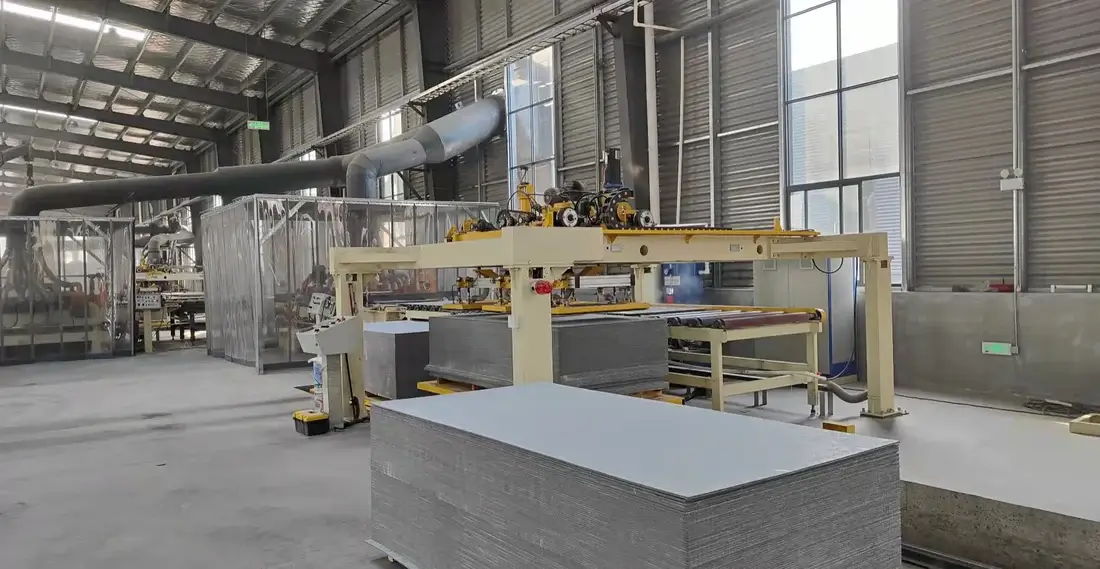
A factory choosing a Fiber Cement Board Sanding Machine Supplier should look beyond the condition of one demonstration sheet. The supplier must be able to deliver a machine that fits the buyer’s cured-board range, explain its abrasive and maintenance requirements, coordinate with existing conveyors and support meaningful tests after installation. For a producer already operating a finishing hall, downtime and the availability of correct replacement parts may be as important as the initial machine purchase. Zhonghong lists a Sanding Machine for fiber-cement and calcium-silicate boards, with related Board Cutting, Grinding & Chamfering, Roller Conveyor and Electrical Control Cabinet equipment. Its finishing-machinery range establishes the relevant product families, while the scope of spares, shipment, dust controls and on-site service must be verified in the actual quotation.
A building-board factory buying its first sanding station is planning an additional process and the layout around it. A second plant replacing an older unit has an existing product, material flow and operating team. The second customer should not assume that a new machine can simply occupy the old floor space without changes to dust extraction, board supports or control signals. The supplier should recognize the difference instead of sending an identical generic specification to both buyers.
Supplier evaluation begins with the cured board and its accepted finish
Each industrial sanding project needs a product reference: the intended dimensions, the incoming board condition, the surface or thickness result expected and the production route that follows. Without this, a supplier demonstration cannot establish whether the offered machine meets the customer’s commercial requirement. A board used behind another finish and a visible wall panel may need different treatment even when both are called fiber-cement boards.
Surface appearance and final thickness need independent acceptance criteria
Zhonghong documents sanding as a function for cured-board surface and thickness treatment. The factory should state whether the purchase is intended primarily to produce a visibly acceptable face, to establish a final thickness or to perform a defined combination. These are different tests. The website does not publish a universal stock-removal allowance, abrasive configuration or finished tolerance, so those values must come from the supplied machine and approved trial.
Imagine a distributor whose customers complain about a visually inconsistent face but are satisfied with the dimensions. A machine offered solely around thickness-calibration capacity might not answer that purchasing problem. A second factory with reliable surface appearance but inconsistent thickness needs another acceptance discussion. The supplier should examine actual board samples and the required result rather than promise that one impressive workshop demonstration covers both.
Incoming defects from board splitting cannot be assigned to sanding
After an applicable curing route, Zhonghong’s Board Splitter separates cured sheets from curing pads and positions them for later operations. If material is damaged during that handoff, an incoming sanding machine may be unable to restore the board to acceptable condition. A supplier should ask for samples taken before finishing and consider whether the factory needs a handling correction or a new sanding unit.
For an existing site, this can be investigated during a process survey. For a new plant, the splitter, conveyor and sander can be engineered as a connected route. The same machine supplier may be capable of discussing all three, but it should identify which components and services are actually included in the quote. Scope clarity is part of reliable procurement, not a secondary administrative task.
A useful sanding-machine supplier should document consumables and service access
Industrial abrasive equipment requires maintenance appropriate to its mechanical configuration and board material. Buyers should request component identification, servicing instructions and the agreed spare-parts scope. A manufacturer can legitimately supply an industrial sander without promising unlimited inventory or a fixed replacement interval. The company’s public pages do not verify universal consumable lifetimes or a stock level for every export destination.
Correct part identification matters more than a generic spare-parts promise
A plant operator needs to know which components are installed and how a replacement will be matched to the delivered machine. A list of common spare-part categories may be useful, but it is not sufficient when an actual technical issue arises. The supplier should provide equipment identification, relevant drawings and references tied to the supplied configuration.
Consider a factory processing boards over several shifts. If maintenance staff discover a worn component during a planned shutdown, accurate part information can help the plant determine the next action. A promise that a supplier has “plenty of spares” is not a measurable commitment unless the relevant components and commercial terms are specified. The buyer can request an agreed initial spare package, but its quantity and contents must be based on the offered machine rather than invented as a general standard.
Dust management must be evaluated for the actual sanding application
Abrasive processing of mineral-based boards can generate dust, so the supplier should identify the extraction or enclosure interfaces associated with its equipment. Suitable safeguards and operating arrangements depend on the installed process and destination requirements. General machinery-safety guidance such as ISO 12100 supports reviewing hazards and maintenance access, but it does not certify that a particular Zhonghong sanding machine includes an unnamed extractor or meets a specification not shown on the site.
An existing finishing hall may have extraction equipment that the owner hopes to reuse. The supplier should assess whether its connection and performance requirements suit the proposed machine, without assuming that any present system is adequate. A new plant must allocate responsibility for the dust-management arrangement from the beginning. The cost of a sanding machine without necessary site services can be misleading if compared with an integrated finishing package.

Which adjacent equipment should appear in a sanding-supplier quotation?
Sanding is not isolated from finishing flow. Zhonghong lists a Board Cutting Machine for final dimensions, a Grinding & Chamfering Machine for edge treatment, Roller Conveyors for transfer and Board Loading & Unloading Machines for certain handling operations. These are distinct offered categories. Buyers should compare proposals by what is included, what is supplied by another contractor and what remains part of the owner’s plant.
Cutting and sanding should not be sold as an undefined combined service
A supplier might offer to integrate cutting and sanding into one finishing route. That may be useful for a specific board product, but the quotation must define which dimensions or surface requirements belong to each operation. A cutter producing final sheet size and a sander refining the broad face have different mechanical and acceptance tasks. Neither should be claimed to perform the other automatically.
For a distributor processing mixed stock-board dimensions, the line may need a clear product-change procedure and suitable receiving supports. An investor manufacturing one standard board might need a simpler flow. The supplier should show how those scenarios influence the equipment and controls it proposes. The cured-board cutting article explains why this distinction matters to finished dimensions.
Loading and unloading interfaces can determine the practical rate of the sander
A sanding unit may be able to run at its intended operating setting while the preceding loader or following conveyor becomes unavailable. The line control should manage material that is already in movement according to the agreed safe operating sequence. Zhonghong’s Intelligent Line Control System and Electrical Control Cabinets offer PLC-based coordination, but the specific signals and software functions belong in the project proposal.
For an established factory, the supplier should request information about retained equipment. A new sanding machine may differ from the old one in receiving level, discharge position or connection requirements. A machine maker willing to review those interfaces before manufacturing provides more meaningful support than one whose quotation assumes every existing conveyor can be reused without modification.
A supplier serving both fiber-cement and calcium-silicate board plants should also explain which parts of the proposed machine configuration are supported by trials on the specific product. Those board families may share industrial finishing needs without being identical materials. The customer should not assume that a single demonstration proves suitable surface processing across every grade. When the intended factory handles more than one cured-board product, a supplier comparison can request samples and distinct acceptance conditions for the commercially important range.
This becomes particularly relevant when a plant uses the same finishing hall for several board lines. The operator may need different product identification or a documented changeover sequence. Those requirements should be evaluated against the offered handling and control equipment, rather than treated as automatic features because the supplier also manufactures other building-board machinery.
Factory inspection, shipment and installed trials are different supplier promises
Buyers often treat a successful workshop demonstration as proof that a sanding installation is complete. In reality, the site may still need utilities, conveyors, board samples, product-specific acceptance testing and operator training. Zhonghong describes manufacturing, transport, installation and commissioning services, but the actual scope and tests should be agreed for each order.
Inspect the manufactured machine against its approved drawings
At the supplier’s facility, the buyer may verify equipment identity, assemblies and selected mechanical or electrical functions. The relevant drawings should correspond to what is being shipped. A photograph of another machine or demonstration on an unrelated board grade cannot prove the performance of the model being purchased. The workshop file should clearly indicate what was witnessed and what remains for the factory site.
A mechanical machine frame, electrical cabinet and handling components can require different shipping protection and installation instructions. The supplier should prepare the actual packing list and identify equipment requiring site assembly. The reviewed Zhonghong materials do not establish one universal export packing method or fixed lead time for every sanding machine, so these details must be negotiated against the customer’s project and location.
Site acceptance needs the approved board and the actual finishing line
The final trial should use representative cured sheets and show how they are received, sanded, inspected and delivered to the next station. A plant making two important grades may need a separate trial for each. A supplier’s demonstration of equipment movement while empty is useful but does not establish that the intended product achieves the required surface or thickness under the installed conditions.
The buyer should also decide what happens when a downstream station stops and how the operators will restart the flow. Staff training should reference the real machine and its controls rather than be limited to a generic company presentation. The sanding product guide discusses the technical process; the supplier decision concerns the documents, services and tests the provider will actually deliver.
Compare suppliers by their response to one realistic factory problem
Before choosing a sanding-machine supplier, the buyer can describe a specific product problem: unacceptable face appearance, thickness variation or a transfer delay at the finishing station. The proposed equipment and service package should identify which issue it will address and which assumptions require further process testing. A new factory may need a complete sanding and handling arrangement; a retrofit may need one machine and carefully defined interfaces.
The manufacturer’s best evidence is an accepted board, not a broad claim
A suitable supplier can show what machinery is being built, how it will be installed and what board will be used for acceptance. It should distinguish actual machine functions from unverified performance numbers. The company’s manufacturing and engineering overview can help buyers understand Zhonghong’s service categories, while the equipment directory identifies the related machine families.
A sanding purchase makes business sense when the completed installation produces a defined, acceptable cured board and the owner understands its operating and maintenance responsibilities. A supplier who can document those details is offering more value than an attractive machine with undefined consumables, interfaces or final product tests.