


Fiber Cement Board Loading and Unloading Machine: Preventing Damage at Finishing Handoffs

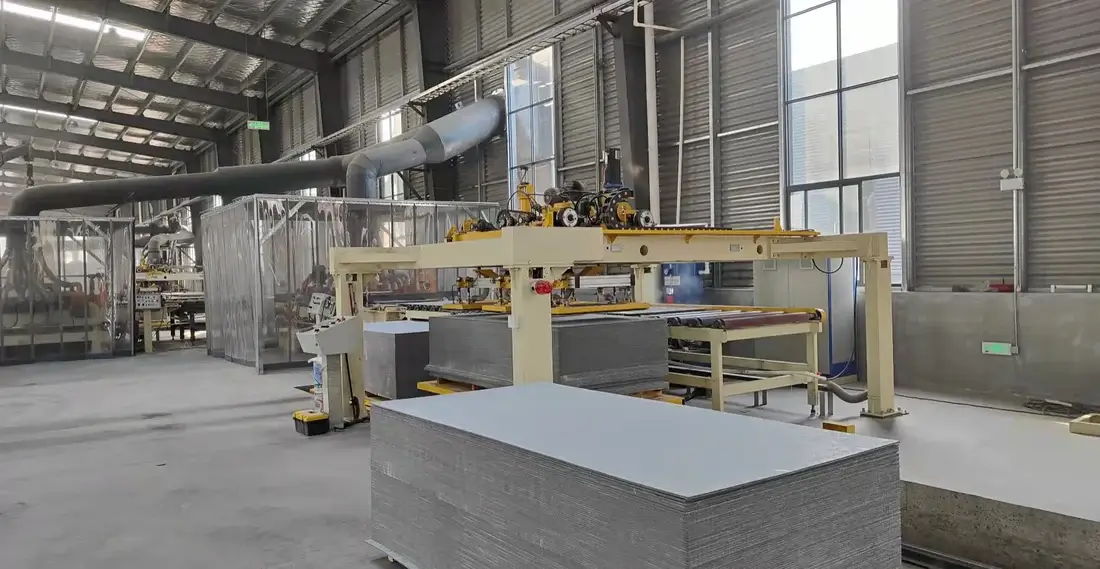
A Fiber Cement Board Loading and Unloading Machine should be bought for a clearly defined transfer into or out of a production station. A board entering a sanding line, a cured sheet leaving a finishing cutter and a stack being prepared for inspection can create different handling requirements. The practical starting point is the finished or intermediate board’s size, surface condition, weight-bearing support and the station that must receive it. Zhonghong lists a Board Loading & Unloading Machine, Roller Conveyor, Sanding Machine, Board Cutting Machine, Board Splitter and intelligent line controls in its board manufacturing equipment range. These are real equipment families, but the public catalogue does not establish that one loading mechanism is universally suitable for every green or cured sheet or that it includes a specified robot arm, vacuum configuration or stack height.
Imagine a factory whose cured boards arrive at the finishing hall but require repeated manual repositioning before sanding. The relevant improvement might be reliable single-sheet feeding. Another factory cuts finished panels successfully but has staff repeatedly lifting them between discharge and packaging. Its requirement is an output-handling operation. Both customers may ask for automation, yet the direction of transfer, product condition and receiving equipment should lead to different machine specifications.
Which loading or unloading movement is the factory trying to automate?
The words “loading” and “unloading” can conceal the actual unit being moved. The factory may handle a single board, a stack of cured sheets, a mould plate or a trolley. Zhonghong’s equipment range includes several separate functions for these movements, including a Roller Conveyor and a Shuttle Car. A purchaser needs to identify which material moves through the proposed machine, how it is supported and where it must be positioned.
Feeding cured sheets into a sander is a single-board task
A Sanding Machine works on the surface and thickness of cured boards. If sheets arrive in stacks, the feeding equipment must deliver the appropriate board condition at an acceptable pace without damaging the surface before sanding begins. The exact mechanism depends on the proposed equipment and cannot be inferred from the broad category name. A supplier should show how the board is separated, presented to the receiving conveyor and accepted by the sander.
An operator whose boards vary in width should provide the actual commercial product range. A transfer that handles the launch size may require further testing for another format. For a factory servicing architectural panels with a visible finish, even minor handling marks could affect acceptance. A buyer should therefore inspect board condition immediately before and after the loading operation rather than only observe the motion of the equipment.
Removing finished panels from a cutter is a different job
At the end of finishing, Zhonghong’s Board Cutting Machine establishes the cured sheet’s final dimensions. Its downstream handling system may need to separate accepted and rejected pieces, transfer panels to an inspection location or prepare them for a packing arrangement specified by the customer. An unloading machine should support those tasks without introducing new edge damage.
Consider a distributor that sells both standard square-edged sheets and a second product with defined edge treatment. The final unloading and packing plan may need to distinguish those variants. If the plant mixes them after cutting, a correctly manufactured panel can still become the wrong item in an order. The control and handling proposal should reflect real product identity, not merely how fast a finished sheet can leave the cutter.
Board condition is the critical difference between forming-area and finishing-area automation
Fiber-cement sheets change throughout production. A fresh wet sheet leaving Hatschek or Flow-on forming is different from a cured board arriving at sanding and final sizing. Zhonghong offers a Board Stacker for servo-controlled green-board positioning, a Stripping Machine for mould-plate separation and a Board Splitter for separating cured boards from curing pads. These machines should not be collapsed into one generic loading-and-unloading operation.
A green-board stacker should not be replaced by a finished-board loader without trials
The Board Stacker is documented for organizing fragile green material before later process stages. A machine designed for rigid cured sheets may have a different support or handling arrangement. An investor considering one handling device for several operations should ask the supplier to test each material condition separately. It would be misleading to infer universal compatibility from a servo motor or a vacuum-related feature.
A new factory can plan green and cured material routes at the same time, but that does not remove their differences. A retrofit customer should state exactly which part of the process the machine will enter. If an older board stacker remains in place, the new loading machine should not interfere with its material route or controls. The goal is a coherent line, not a collection of separately automated stations.
Board-splitting and mould-plate stripping have their own return paths
A Board Splitter separates cured sheets from curing pads; a Stripping Machine handles a board and its mould plate in another process context. Both may produce a reusable support as well as a board moving onward. A loading or unloading quote that names only the board can miss equipment needed to return the plate or pad. That omission can turn a seemingly automated installation into a process that still depends on repeated manual intervention.
For a plant experiencing a shortage of available supports, replacing the board-loading equipment may not be enough. The maintenance and operations teams should inspect where supports accumulate and where the line is waiting. The cured-board splitting guide explains the post-curing route, while the mould-plate article examines a different separation stage. Either may be more relevant than adding a generic finished-board loader.

Physical layout and operating rhythm should be assessed together
Loading machinery can reduce repeated manual handling where it is technically appropriate, but it must fit the factory’s space and process sequence. The buyer should locate the board’s starting position, receiving height and available working area on the installation drawing. The next station’s operating rhythm also matters: a loader delivering material more quickly than a sander can receive it can create an accumulation problem instead of improving useful output.
Stack position, feed elevation and available access require drawings
An equipment proposal should identify the format of incoming boards and the physical position from which they will be removed. A finishing workshop may have existing platforms, conveyors or walls that restrict the installation. Without accurate site measurements, a machine can pass inspection in the supplier’s factory and still be difficult to fit into the customer’s plant.
Zhonghong’s catalogue confirms the availability of loading and unloading machinery but does not publish one universal machine footprint, stack capacity, arm travel or working height for all projects. Those details must come from the offered configuration. A buyer should compare machine drawings against retained equipment and distinguish supplier manufacturing from civil work or other site preparation.
Discharge timing must respond to the receiving machine
Imagine a finished board has been released from the cutter, but the packing conveyor is occupied. The unloading equipment should follow a safe agreed response rather than send another board into an unavailable space. The supplier should describe the relevant ready, occupied and completion conditions in the control narrative. A machine that moves automatically when tested alone has not necessarily demonstrated the complete industrial handoff.
Zhonghong offers Electrical Control Cabinets and Intelligent Line Control Systems with PLC-based coordination and production monitoring. These are documented capabilities, but a specific loading machine’s station signals must be included in its quotation. An operator should know which action is automatic and which requires staff intervention. This is particularly important when the new loader connects to machinery supplied by another company.
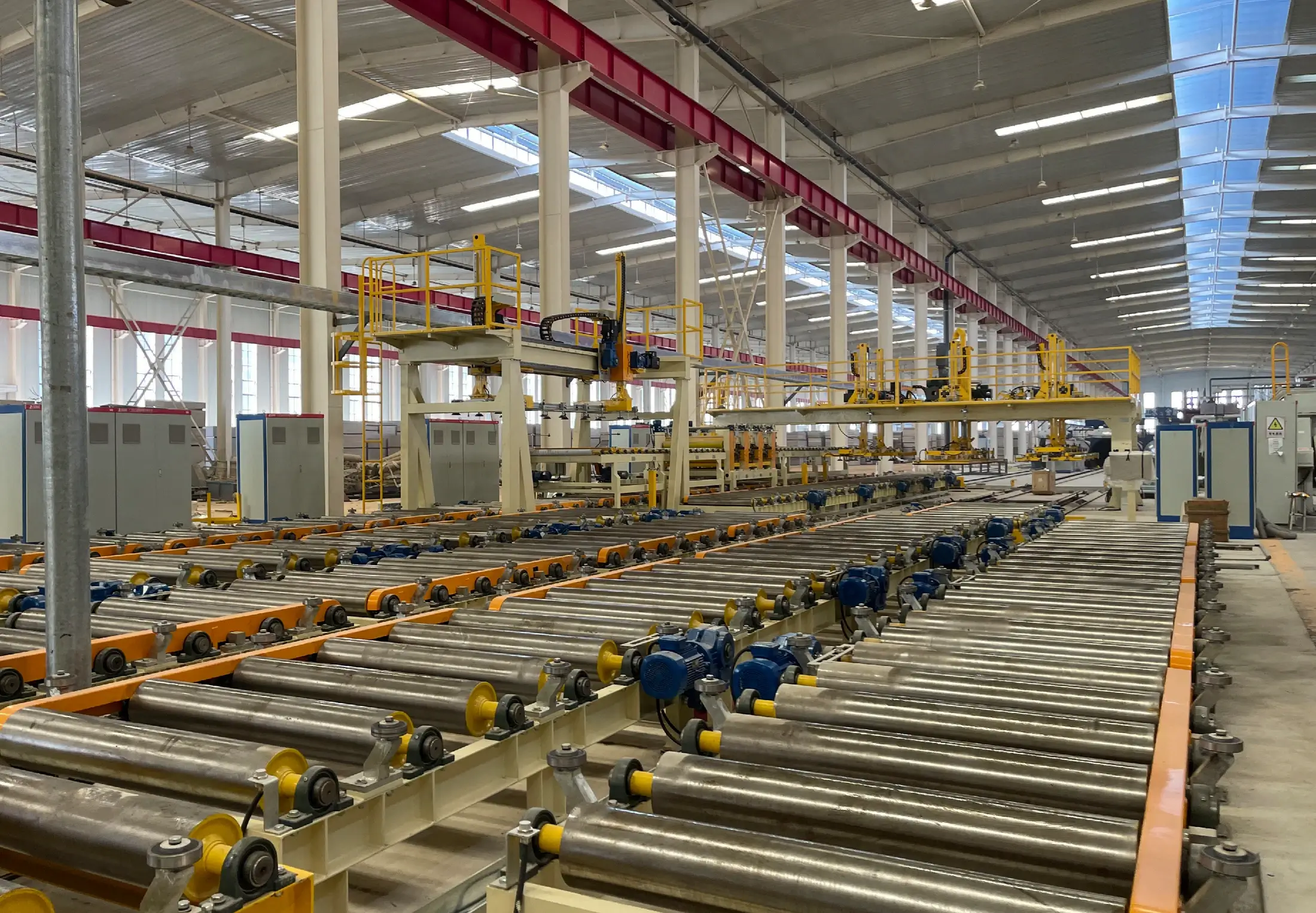
Is a loading-and-unloading upgrade the right investment for the finishing hall?
In an existing plant, the decision should begin with observed work. Repeated manual lifting, poorly timed transfer and preventable handling damage are different problems. The buyer can document when boards wait, where they are repositioned and whether the current upstream or downstream equipment creates the constraint. A new loading machine makes sense when its role and accepted result are clear.
Compare operator handling with the board transfer that the machine would perform
If staff repeatedly lift heavy boards or place them in a precise orientation before a sander, mechanical transfer may be valuable. But the proposed machine should be evaluated for the actual board formats and condition. An investor should not assume that any specific staffing reduction will follow from purchasing one loader without a time-and-motion review of the real factory.
A distributor producing mixed-size boards may have more product changeovers than a factory selling one standard sheet. The automated handling route should account for those planned variants instead of being optimized solely around the easiest demonstration board. Where an offered range is unverified, the supplier should label the additional formats as requiring trials rather than promise unrestricted operation.
Final acceptance requires boards, not an empty handling demonstration
Workshop inspections can establish machine identity and selected mechanical or electrical functions. Site acceptance should use representative boards, include the receiving equipment and evaluate the finished condition after handling. A supplier can test the movement of its machine before shipment but may need the customer’s actual boards and site layout to prove the full transfer sequence.
For an export project, assembly and service requirements should also be documented for the equipment ordered. A mechanical handling structure and an electrical cabinet can require different protection and lifting methods, and the buyer should receive appropriate installation instructions. Zhonghong describes manufacturing, transport, installation and training as available services, but the precise package must be stated for the project.
Product identification can matter as much as automatic lifting
Loading and unloading also influence how the factory keeps its output organized. A plant making multiple board thicknesses might have the right sheets in the correct stacks at the finishing entrance but still risk mixing products when they leave the cutter or sanding line. The handling system should therefore be evaluated against the operator’s actual product identification and inspection process, not only the movement performed by the machine. There is no basis to claim that Zhonghong’s standard loading equipment includes a particular barcode, scanning or tracking function without a project-specific specification.
Mixed-board shipments need a controlled handoff to inspection
For a distributor who orders standard lengths and two thicknesses, the factory should know how approved boards are identified after processing. If the planned loader or unloader deposits finished sheets onto separate supports, that arrangement should match the product and the receiving inspection workflow. A supplier can show where each output moves and how the plant would avoid accidental mixing during a changeover. These are specific distribution requirements that need not be relevant to a factory making only one standard sheet.
Any proposed automatic classification feature should be verified with representative products, a documented signal source and a clear operator response when the identification is uncertain. Otherwise a factory may automate the movement of boards while leaving a material-quality or order-fulfilment problem unresolved. The correct equipment decision supports both physical handling and the way a buyer will receive the finished product.
Define one successful material handoff before adding more automation
A new factory can integrate loading and unloading into a planned process from the beginning. An operating facility needs to identify what existing machinery will remain and what measurable problem the new device must solve. Both customers should ask for the same fundamental evidence: where the board starts, how it is supported, where it is delivered and what happens if the next station stops.
The roller conveyor guide examines board support between process stations, while the sanding article explains one potential receiving operation. The company’s broader equipment range helps identify which machine family is appropriate. Choosing the right loading or unloading function is less about a machine performing more movements and more about a board reaching the next operation in the condition the customer expects.