


Fiber Cement Board Hydraulic Press: When Pressing Is Justified by the Board


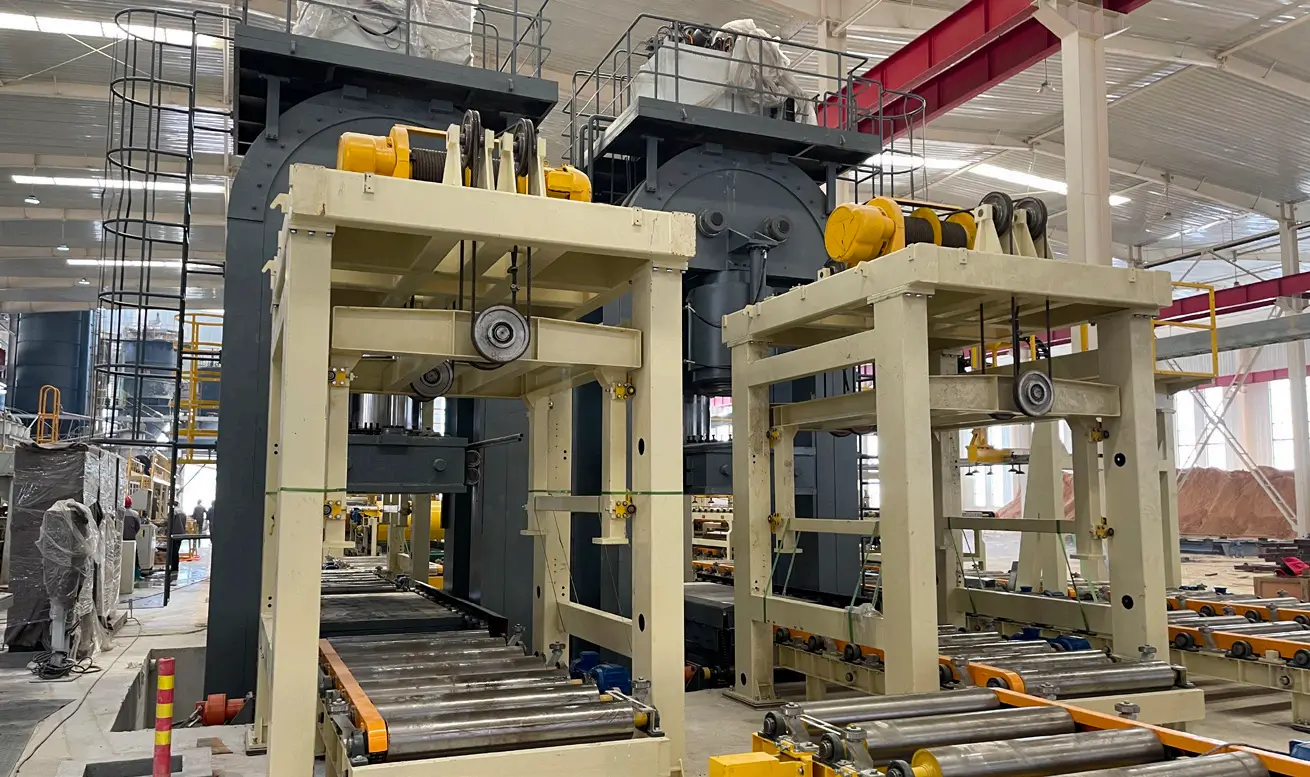
A Fiber Cement Board Hydraulic Press should be selected because a particular board process requires controlled pressing, not because every fiber-cement plant needs the largest press it can afford. The useful buyer questions concern the board’s condition before pressing, its supporting or stacking arrangement, the outcome expected from the press, and how the material will be moved toward curing or another operation. Zhonghong lists a Hydraulic Press for certain higher-density board production routes, alongside Hatschek and Flow-on forming equipment, a servo-controlled Board Stacker, a mould-plate Stripping Machine and an Autoclave Curing System. These are distinguishable machinery families in the production equipment catalogue. An investor should first identify the planned board and demonstrate which of those operations it needs before agreeing a pressing-machine specification.
Consider a factory planning a dense flat sheet for a defined market. It may have a credible reason to evaluate a press within its process design. Another operator producing a different board might be adding cost and complexity by including one without product-trial evidence. The buyer should distinguish requirements demonstrated by the material from assumptions copied from another factory’s equipment layout. A press can be manufactured correctly and still be the wrong machine for the intended product route.
What can pressing change before fiber cement boards are cured?
Pressing is a mechanical processing stage whose usefulness depends on the state of the incoming material and the manufacturing route. In some fiber-cement systems, stacked sheets may be pressed before subsequent curing or other treatment. This does not make pressing a universal substitute for properly controlled formation, material composition or curing. A buyer should ask the process team to describe the intended change to the board and the tests that will determine whether the pressing operation is justified.
A green board arrives with conditions established at the former
Before pressing begins, the line may create sheets by accumulating layers in a Hatschek former or through slurry distribution and dewatering on a Flow-on forming system. Both deliver material shaped by the prepared slurry and wet-end operation. The press therefore receives a board whose thickness, moisture state and handling support have already been influenced upstream. If forming is inconsistent, applying pressure is not a guaranteed remedy for defects originating in the wet layers.
An owner upgrading its existing press should document the incoming board and the problems it intends to solve. If boards vary in thickness at the press inlet, a trial should determine whether that variation originates in forming, transport or another operation. The engineering team should not promise a uniform finished product from one isolated pressing action when important upstream conditions remain undefined.
Higher-density products still require product-specific validation
The company identifies its Hydraulic Press as part of the route for certain higher-density boards. That is a documented function, but the website does not publish one guaranteed strength, density increase or press recipe for every material. These performance questions depend on the formulation, the manner in which pressure is applied and the subsequent production stages. A supplier needs a trial-board plan rather than an unsupported claim that a bigger press automatically creates a stronger board.
For a contractor purchasing boards to a defined product specification, pressing is relevant only insofar as it supports manufacturing an acceptable finished sheet. A factory investment proposal should therefore separate a machine’s mechanical capability from board properties measured after the appropriate curing and finishing route. A machine pressure figure alone cannot establish how a wall or ceiling board will perform in use.
The supporting stack determines what a hydraulic press can receive
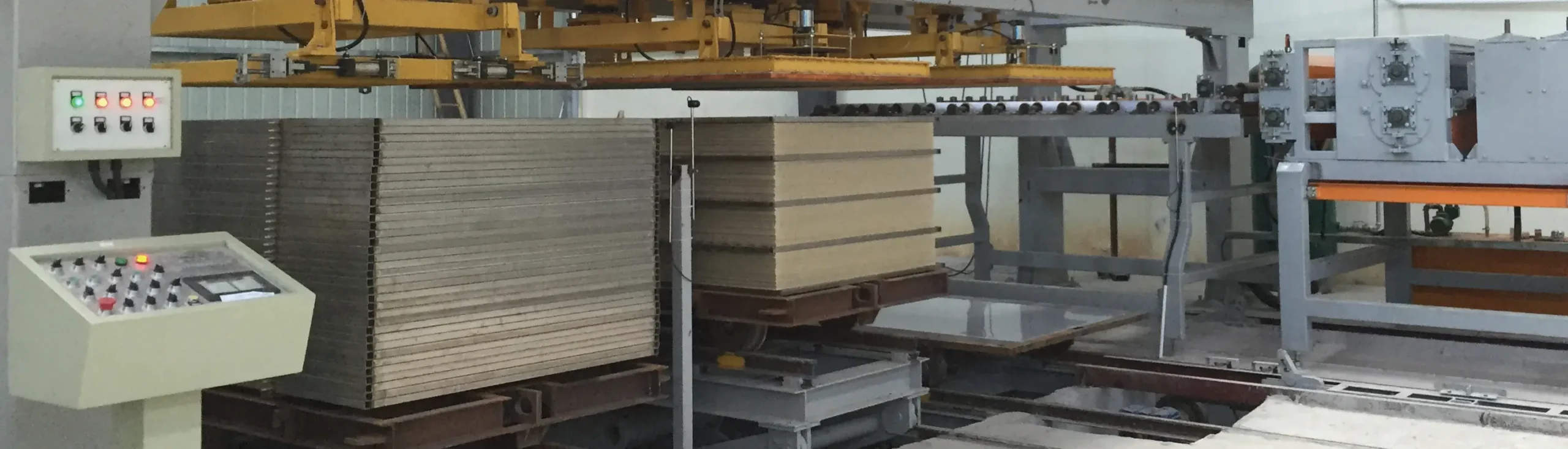
Pressing equipment works within a line, not on an undefined item. Zhonghong lists a Board Stacker with servo-controlled positioning and a Stripping Machine that separates boards from mould plates using suction lifting and servo-controlled travel. Depending on the selected process, these or other transport operations may surround the press. The buyer should ask for drawings identifying the stack, any mould or support plates, the inlet and discharge positions and the movement required between stations.
Stack preparation must match the product and available support
A newly formed board can be more vulnerable than a fully cured sheet. A stack assembled for pressing may therefore have handling requirements that differ from the product’s final packing arrangement. The project team should state what the press receives and how its supports are prepared. A supplier should not assume that any collection of green boards is suitable for an unspecified pressure cycle.
Suppose an investor intends to make two board thicknesses. Changing the wet forming target may alter the incoming stack and its handling pattern, even if the press frame is unchanged. The equipment proposal should explain how the selected range is supported, what remains subject to trial and whether any extra preparation or transfer equipment is required. A generic statement about variable production is not a substitute for that engineering decision.
Mould plates and press supports are part of the machine interface
If the production route uses mould plates or other supports, their geometry and path through the pressing operation should be documented. The Stripping Machine’s task is to separate boards from mould plates; it is not itself a hydraulic press. These functions should be placed correctly in the process diagram so the plant knows when plates are present and where they are sent after use.
An operating factory may retain its mould plates and conveyors while replacing the press. The supplier then needs accurate interface measurements and the constraints of the existing plant. A press may appear to fit in the available space but still require changes to loading, unloading or control wiring. Those interfaces are frequently more relevant to the practical installation than a general claim about the strength of the press frame.
A hydraulic press is not a replacement for steam curing or final finishing
A board plant may include pressing, autoclave curing, board separation and final surface processing, but those are different functions. Zhonghong lists an Autoclave Curing System for high-temperature, high-pressure steam treatment of relevant fiber-cement and calcium-silicate products, and downstream machines including a Board Splitter, Sanding Machine and Grinding & Chamfering Machine. The equipment schedule should explain which operations apply to the planned product and why.
Steam-curing conditions have to be established for the actual board
Where a product uses an autoclave, treatment parameters and loads must be developed against the material system. A hydraulic press does not certify the chemistry or performance of a future board, nor does a generic autoclave photograph establish a universal curing recipe. The buyer should ask which product trials connect pressing to later material treatment, and which aspects remain conditional on formulation approval.
A plant whose commercial output is constrained by curing load preparation may not benefit from purchasing a faster press first. Improving one station can shift waiting time to another. An engineering review needs to follow the real board through the selected processing stages and identify whether the press is a genuine constraint. The equipment bottleneck article discusses this broader factory-output question.
Sanding and cutting cannot correct every upstream process fault
Zhonghong’s Sanding Machine addresses cured-board surface and thickness requirements, while its final Board Cutting Machine establishes dimensions after curing. These are separate downstream tasks. If an owner intends to use finishing machinery to compensate for substantial inconsistency in pressing or wet formation, the process team should investigate whether the material and equipment route is appropriate before relying on extra removal of material.
For a visible architectural-facing panel, a consistent surface may be commercially important. For a board sold as an interior substrate, dimensional reliability may take greater priority. The pressing route should support the chosen commercial product, not define it. A buyer should specify the finished board’s requirements first and then determine which processing stages are necessary to reach them.
What mechanical and electrical evidence should accompany a press quotation?
A machine supplier can verify certain fabrication and assembly details before shipment. The buyer should request the actual press drawing, its stated operating functions, the included electrical and hydraulic interfaces, site installation requirements and documentation for safe operation. The current Zhonghong product pages do not publish a standard tonnage, table dimension, stroke, speed or universal pressure cycle for every Hydraulic Press. Quoting another manufacturer’s numerical specification as Zhonghong data would be misleading.
A workshop press test should not pretend to certify finished boards
Before delivery, a factory inspection may establish machine identity, selected movements, parts of the hydraulic operation and the agreed electrical or protective functions. Those checks help verify the machinery supplied. A separate product trial should then use the intended material and process route to determine whether the actual board satisfies the buyer’s requirements. An empty-machine demonstration does not prove that every possible formulation will produce an acceptable sheet.
For an international plant, transportation and installation planning should reflect the machine’s real assembled dimensions and required site connections. A large fabricated structure, hydraulic equipment and electrical cabinet may need different packing and lifting arrangements. Zhonghong describes packaging, transportation, installation and commissioning among its services, but the actual responsibilities must be stated for the press being ordered rather than assumed from general company information.
Safety and maintenance access depend on the installed layout
A hydraulic press introduces mechanical and hydraulic hazards that must be evaluated for its actual use, installation and servicing. Industry machinery safety principles help buyers ask about intended operating modes, access and protective functions; they are not a substitute for the supplier’s project-specific documentation or destination requirements. A machine’s safety review should include interaction with loading and unloading equipment, not only the press structure itself.
A plant owner should ask where operators perform routine inspections and what must be isolated before maintenance. Hydraulic equipment, moving supports and nearby transport machinery have different servicing needs. No fixed maintenance interval or spare-parts inventory is established by the current website for every press model. The supplier should provide the instructions and component information applicable to the unit delivered.
How to decide whether a hydraulic press is the next machine to buy
The answer differs for a new factory and an operating plant. A greenfield investor should start with the board specification and decide whether pressing is necessary for the validated process. A retrofit operator should investigate where its existing press fails to meet product requirements or disrupts material flow. Neither needs the most elaborate machine as an end in itself; the value lies in solving an identifiable production constraint.
New factories should validate the board before committing to a press range
Develop the material and forming basis, identify whether higher-density pressing is intended, and agree the trial-board criteria that will justify the selected equipment. The forming route, stack preparation, optional pressing and subsequent curing may all affect the product’s final properties. A supplier offering turnkey engineering should be able to explain those connections without inventing a guaranteed product result before testing.
Zhonghong’s whole-line planning guide provides the larger production context, while the stacker article deals with preparing material for downstream processing. These sources can help buyers separate equipment functions, but the actual press specification still needs its own project drawings and acceptance conditions.
Retrofit buyers should examine the old press’s neighbours first
A factory with repeated loading delays might need a better handoff between stacker, press and plate-handling system rather than a new hydraulic frame. A plant whose pressing action is no longer suitable for its approved product has a different problem. Before requesting an offer, record the board condition at the press inlet, the existing support or plate geometry, discharge requirements and the operating problem staff actually observe.
A sensible press purchase is supported by a demonstration that the selected board enters the equipment correctly, receives the intended treatment, and moves onward to the next stage without an undocumented change of process. If the supplier can show that sequence and identify what remains subject to finished-board testing, the owner has a sound basis for the investment.