


Fiber Cement Board Making Machine: What One Machine Can—and Cannot—Produce


A buyer searching for a fiber cement board making machine may imagine one machine receiving raw materials and delivering finished, saleable boards. Industrial production does not usually work that way. A forming machine creates a wet sheet, while other equipment prepares the slurry, cuts and handles green boards, applies the specified curing treatment and finishes the product. The first procurement question is therefore whether the project needs a forming station, a group of connected machines or a complete factory. Zhonghong’s equipment range includes a Ball Mill, Automatic Dosing System, Slurry Storage Tank, Hatschek and Flow-on Forming Machines, Waterjet Cutting System, Board Stacker, Hydraulic Press, Autoclave Curing System, Sanding Machine and supporting controls. The appropriate combination depends on the board and the conditions at the site.
Consider an entrepreneur preparing to sell flat fiber-cement sheets for building interiors. A quotation offering only the former might look less expensive than a complete plant. But if the buyer does not already have the preparation, curing and finishing operations needed for the intended product, the comparison is misleading. A different buyer replacing a worn forming machine in an established factory may need precisely that narrower equipment package. The same search phrase can describe two fundamentally different investments.
A fiber cement board making machine is not necessarily a complete factory
Product catalogs may use the term “board making machine” for a forming unit or for a fully integrated collection of equipment. The distinction matters because the equipment responsibilities are different. A former does not automatically contain mineral grinding, slurry dosing, a green-board cutting station, curing vessels and finished-board inspection. These operations may be delivered under one supplier’s project, but the equipment list and service boundaries need to say so.
The Hatschek forming machine is a sheet-forming station
Zhonghong offers a multi-cylinder Hatschek Forming Machine. The established Hatschek process uses rotating sieve cylinders and a felt system to build layers into a green sheet. Its useful procurement specification should connect prepared slurry, wet layer formation, thickness build-up and transfer to the next operation. The website identifies the equipment family but does not publish one universal production rate, thickness range or materials recipe suitable for every plant.
For a buyer with a functioning preparation system and downstream line, an individual former may be the correct purchase. The replacement still needs an interface drawing: what enters from the existing slurry system, which transfer arrangement receives the green sheet and how the new controls connect to retained machinery. A machine designed to make a wet sheet in isolation may require substantial project work before it produces the same board as the old production line.
Flow-on forming serves the same broad stage through a different process
Zhonghong’s Flow-on Forming Machine forms a continuous board layer through controlled slurry distribution, dewatering and thickness control. This does not mean the buyer should choose it only because it sounds more continuous than the Hatschek alternative. The two forming routes have different process details. The target board, available raw materials and evidence from trials should drive the engineering choice.
Raw-material machinery creates the feed that board forming requires
The forming process begins before material arrives at the machine. Zhonghong’s product range identifies equipment for grinding minerals, metering material and holding prepared slurry. Buyers planning a new factory should establish the raw-material route early, because it influences utilities, equipment footprint, process controls and the expected condition of slurry supplied to the former.
Mineral grinding and formula dosing solve different problems
A Ball Mill is offered for grinding mineral raw materials used in fiber cement and calcium silicate board slurry. An Automatic Dosing System meters and combines the inputs to meet a required production formula and slurry concentration. Those descriptions should not be collapsed into “mixing equipment.” Grinding changes the physical preparation of some feedstocks; dosing establishes amounts entering the process. A factory can measure an unsuitable material accurately, or grind a suitable material yet fail to control how it is combined with others.
For example, a buyer intending to use local silica-bearing material should not assume an arbitrary catalog grinding specification will be appropriate. Material characteristics require investigation, and the formulation team must define what the forming process needs. If a manufacturer advertises a complete machine set without explaining who is responsible for this study, the buyer may acquire correctly fabricated equipment without an agreed process basis.
Slurry storage connects batch preparation with ongoing formation
Zhonghong lists a Slurry Storage Tank that keeps prepared slurry available between stages. Its role is to support the feed to forming; it is not a substitute for acceptable material preparation. A new plant’s layout should show the route from the preparation system through storage to the former, including required connections and the operator’s response when upstream supply pauses.

Green boards still need cutting, support and a path into curing
When a sheet leaves the former, it is not automatically a finished board. Depending on the intended process, cutting, stacking, pressing or stripping may be required before curing. The wet material’s condition matters to which equipment can handle it. A proposed “complete making machine” that omits the route between forming and curing should be examined carefully.
Waterjet cutting is an upstream sizing operation
Zhonghong’s Waterjet Cutting System uses high-pressure waterjet cutting to size green boards. This is separate from the Board Cutting Machine offered for cutting cured sheets into final dimensions. A buyer should specify which sizes are formed before curing, how boards are supported through the green cut and what finishing cuts are expected afterward. A machine package without this distinction may hide a significant gap in its equipment scope.
A distributor planning to stock a simple range of standard board sizes might initially prioritize reliable cutting and handling for those products. A factory expecting frequent changes in dimensions will need a more detailed discussion of the cutter’s interface with the former and stacker. The correct specification is tied to the order mix, not to a claim that one machine can switch freely among every possible length.
The board stacker may determine what the former can release
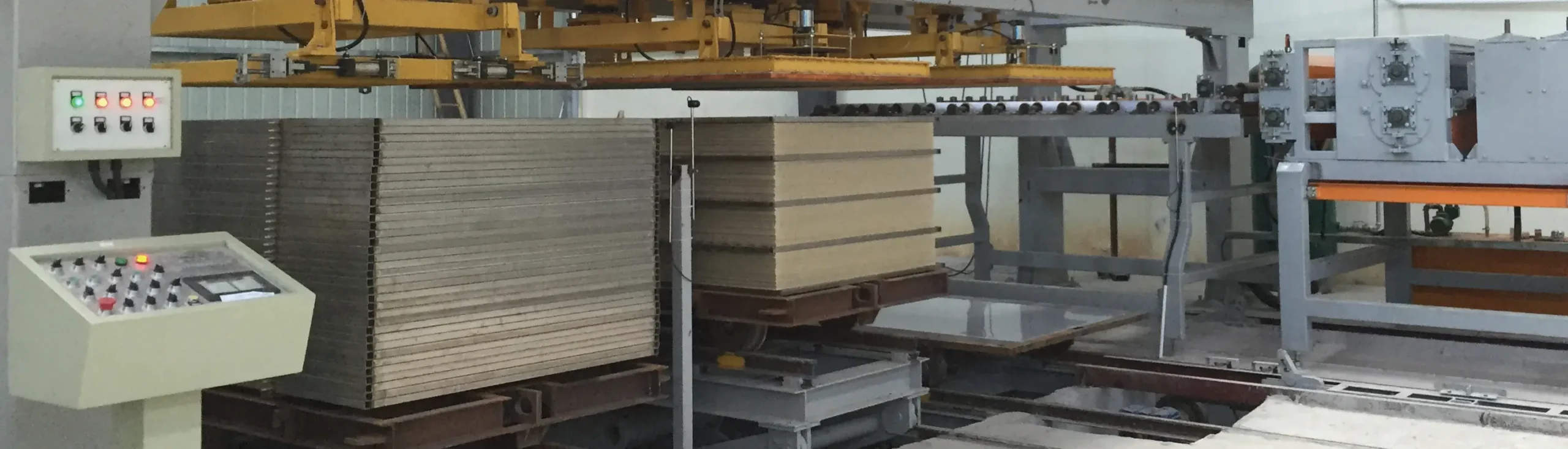
The Board Stacker is documented as positioning and stacking green boards with servo-controlled handling. It must receive the sheet or cut board in an appropriate condition. An investor should ask how a board is transferred, supported and placed, and how the equipment responds when the next process stage pauses. A forming machine’s rated performance is not the factory’s rated performance when the stacker or the following station is unable to accept material.
For an operating plant adding a new former, the buyer should compare the retained stacker’s board-handling arrangement with the proposed green-sheet output. If a new product has different dimensions or a different wet-board condition, integration may require more than changing a motor or a control setting. The process should be tested with representative material, not evaluated solely through empty-machine motion.
Hydraulic pressing and stripping are product-route decisions
Zhonghong offers a Hydraulic Press used in the production of higher-density board products, and a Stripping Machine that separates boards from mould plates with coordinated suction lifting and servo-controlled travel. The need for either stage follows from the board being made and the handling arrangement. Not every supplier’s machine package should contain both. Their presence must be justified by the forming and curing route rather than accepted as mandatory equipment.
Ask the supplier to identify the material the press or stripper receives and where it goes next. A press handling a prepared stack has different requirements from a stripping unit dealing with mould plates. For a factory planning several board grades, any change in these stages should be evaluated as part of a product trial.
Steam curing and finishing determine whether the board can be sold
The factory still needs a route after forming. In Zhonghong’s range, the Autoclave Curing System supplies the steam-treatment stage for applicable boards; a splitter separates cured material from its supports, and dedicated sanding, edge-finishing and cured-board cutting machines prepare saleable sheets. These are stages with distinct functions. A plant quote that includes a former but does not specify curing and finishing should be treated as an incomplete factory proposal unless the buyer already has those operations in place.
Autoclave capacity must follow an actual load and product basis
The autoclave part of a project requires information about board dimensions, stack arrangement, load handling and the proposed curing process. A nominal vessel size does not establish the number of accepted boards the plant can produce. The curing schedule must be developed around the intended material system and product requirements, with conditions verified through appropriate trials. Industry research on hydrothermal processing can explain why this matters, but one laboratory result is not a transferable guarantee for a commercial factory.
A buyer should also ask what equipment moves the load toward and away from curing. Zhonghong offers Shuttle Car equipment for transferring board or mould-plate trolleys, along with a Board Splitter for separating cured boards and curing pads. Whether either item belongs in the selected route depends on the project. The load-handling interface is part of the plant design and should not be assumed from a standalone machine catalog.
The finished face and edge specify the last machines required
The Sanding Machine addresses the surface and thickness of cured boards, the Grinding & Chamfering Machine prepares edges, and the Board Cutting Machine establishes final product sizes. A factory selling visible wall cladding may need different finishing capability from one making a more basic interior substrate. The buyer’s intended sales specification should describe the accepted surface, edges and dimensions rather than merely asking for “automatic finishing.”
Suppose an investor plans to sell two products, one with a plain cut edge and one with a chamfer. The extra edge treatment may have a commercial purpose for the second product but add little value to the first. Equipment selection and production scheduling should reflect that difference. An unnecessary machine can consume space and capital; omitting a required finishing operation can leave good cured boards commercially unusable.
When the purchase should become a complete engineering project
The buyer who already runs a board factory may only need a well-defined machine and its mechanical and control interfaces. The buyer constructing a new plant needs coordinated process engineering from raw material receipt to finished-board inspection. Zhonghong describes both machinery manufacturing and turnkey EPC engineering, along with installation, commissioning, staff training and production support. The contractual scope must still identify exactly what is included for the project.
Machine supply cannot replace utilities and site planning
Equipment must fit an actual building, foundations and available service conditions. A forming unit needs connections to prepared material, the downstream transfer arrangement and electrical control. An autoclave has different civil, energy and safety considerations. A finishing machine needs appropriate material handling and space for operation and maintenance. Purchasing all of these through one supplier can simplify coordination, but only if the responsibility schedule names where the supplier’s work begins and ends.
For an export project, the machine package should include the documents needed to identify parts, inspect shipments and assemble the equipment. A large forming-machine structure, an electrical cabinet and conveyor frames may require different handling and packing methods. The website does not establish a fixed shipping method, export lead time or warranty applying to every machine. Those details belong in the actual offer.
Board trials should be separated from mechanical commissioning
A machine can pass checks for movement, guarding and electrical function before the factory has established that an intended board meets its commercial specification. Product trials are needed to address the real materials, forming method, curing and final testing. A relevant product standard such as EN 12467 may inform some fiber-cement flat-sheet acceptance requirements, but the correct standard and product category must be determined for the target market. Having equipment capable of participating in this process is not itself product certification.
The complete production-line overview explains Zhonghong’s integrated offerings, while the machine families show individual stations available to configure. A prospective factory owner should ask the supplier to explain which machines appear in the proposed layout, which stages remain outside the price and which assumptions still require material tests. An operating factory owner should do the same for any old equipment intended to remain.
The difference between a suitable making machine and an incomplete factory quotation is visible when the buyer traces one real board. It must have prepared feed, a workable forming process, green-board handling, an approved curing route and the required finish. If a proposal cannot explain how those stages connect, the buyer should resolve that uncertainty before ordering.